
Bulgaria 2025 Lessons Identified Conference: Turning Experience into Readiness
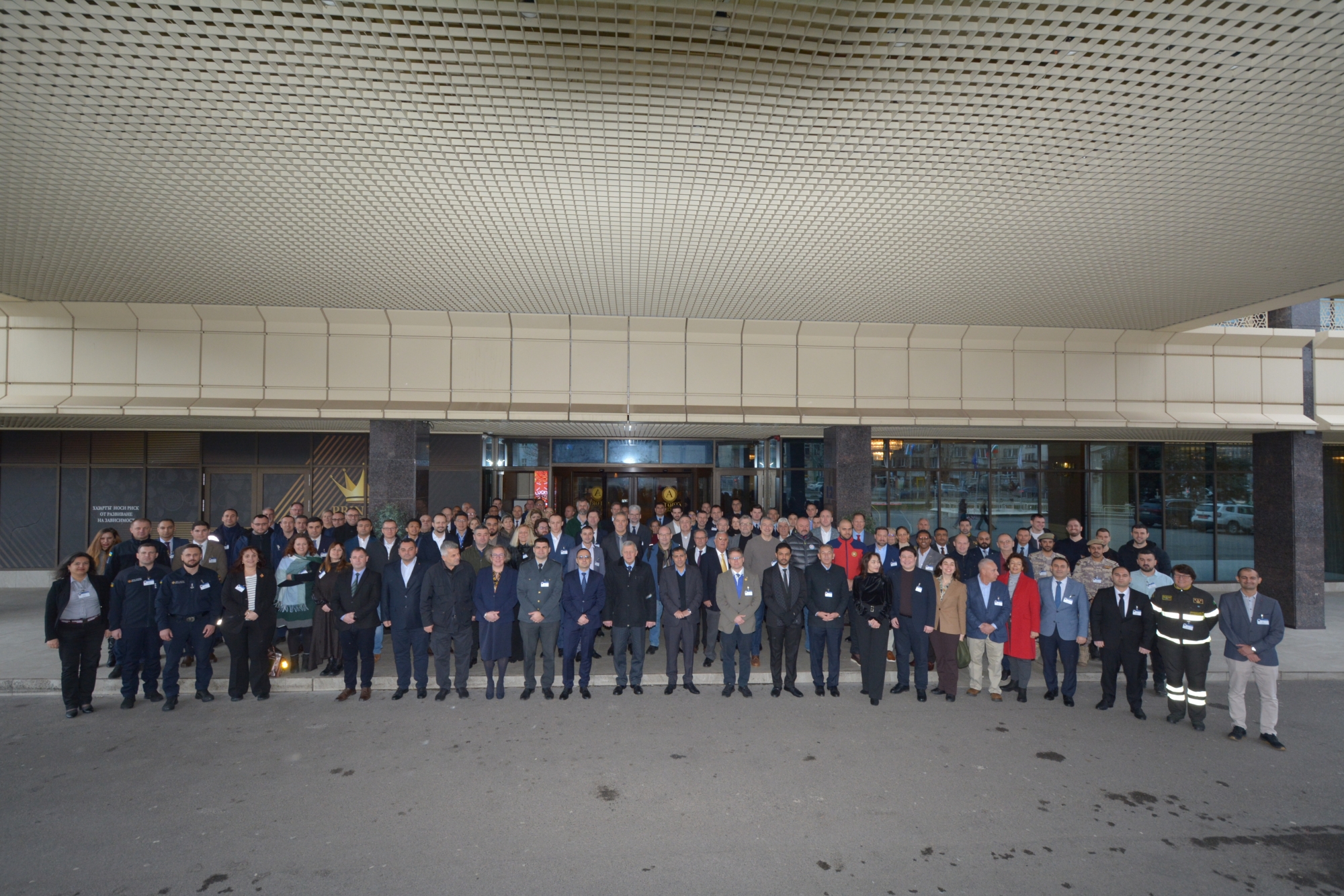
Date: (12-02-2026)
This conference was important because it moved the community from activity to improvement: from what happened in the field to what must change in procedures, coordination, and capabilities – so that the next real emergency finds us faster, sharper, and more interoperable.
A learning event built on a large, complex NATO exercise
BULGARIA 2025 was designed as a high-complexity, civilian-led emergency management exercise – one that trained a wide range of response disciplines while testing the seams between national systems and international support mechanisms. EADRCC exercises are among the world’s largest multinational emergency management activities, and BULGARIA 2025 specifically focused on strengthening resilience, preparedness, and civil-military cooperation.
Sofia as the “bridge” between field performance and strategic improvement
The Lessons Identified Conference held in Sofia captured operational realities and translated them into structured, shareable lessons.
The conference was also a planned milestone within the overall exercise cycle – explicitly included in NATO and exercise documentation as the mechanism to evaluate outcomes and determine next steps.
What we did: structured reflection across the full response spectrum
The conference design followed a practical rhythm to improve future planning processes.
After establishing a common baseline for discussion on Day 1, various working groups addressed the complexity of reality – from the planning phase, through logistics, operational elements, and multi-cell coordination structures, to cross-cutting topics. There was also a dedicated session on research, reinforcing that modern preparedness depends on evidence, data, and learning systems – not only tactics and hardware.
In his closing remarks, the CMDR COE Director, COL Orlin NIKOLOV, summarised the conference in the spirit in which it was conducted: “to turn experience into improvement.” He emphasised that the diversity of operational services, ministries, militaries, international organisations, and research communities was not decorative but essential to transforming complex experience into practical change.
He highlighted three key directions that emerged across the sessions:
Coordination structures matter most under pressure
“In a fast-moving, multi-actor response, clarity of roles, decision rhythms, and information flows can be as life-saving as any tool.”
Host Nation Support and cross-border facilitation are decisive enablers
“These are not merely ‘administrative’ issues; they are operational factors that determine how quickly teams arrive, how long they remain effective, and how safely they operate.”
Resilience and the information environment are inseparable from response
“Public communication, trust, and the ability to withstand malign narratives are integral to crisis management, not an add-on.”
Most importantly, COL Nikolov set a standard for what “success” actually means after a conference:
“Lessons that remain in conference notes do not improve readiness.”
He provided a concrete translation pathway, one that the community can align around immediately:
• Actionable recommendations, prioritised by impact and feasibility;
• Owners and timelines, so lessons become tasks;
• Sharing mechanisms, so improvements scale across Allies and partners.
CMDR COE’s role was stated plainly and practically: to support partners and stakeholders in converting insight into capability, and to remind that real success will be demonstrated in the face of the next crisis, when we will be prepared to act quickly, coordinate more effectively, and communicate more clearly.
The CMDR COE Director also expressed his sincere appreciation to everyone who planned, delivered, evaluated, and supported both the exercise and the conference, especially the EADRCC and the Fire Safety and Civil Protection Directorate. That recognition is well deserved – this was a major multinational endeavour, and Bulgaria’s role as host enabled a demanding training environment and an equally professional space for honest reflection afterwards.
A Lessons Identified Conference is not the finish line – it is the handover point between learning and implementation. Resilience is not built during the crisis – it is built together, before it.
News
 Crisis Response Operations Planners Professional Development Course was successfully conducted
The Crisis Management and Disaster Response Centre of Excellence (CMDR COE) successfully conducted the pilot Crisis Response Operations Planners Professional Development Course from 26th to 28th November 2014.
Numerous experts attended the course including representatives from the Bulgarian Ministry of Defence, JFC, Army, Chief Directorate Fire Safety and Civil Protection under the Ministry of Interior, Bulgarian Red Cross, as well as representatives from the Defence Administration Office and the Ministry of Human Resources of Hungary, and the CCD COE, Estonia.
» read more Successful Accreditation visit to CMDR COE
On 24-25 November 2014, the Crisis Management and Disaster Response Centre of Excellence (CMDR COE) hosted two important events – the 2nd Steering Committee Meeting and the Accreditation Visit from HQ SACT.
During the Steering Committee meeting on 24 November, the SC members approved the proposed Program of Work 2015 of the Centre as well as the proposed CMDR COE budget estimates for FY-2015.
» read more CMDR COE hosted NATO Flag-level StratCom Course
 On 22 October 2014, the Deputy Chief of Defence, Major General Konstantin Popov opened the Flag-level Strategic Communications Course.
Organized by the Ministry of Defence of the Republic of Bulgaria and CMDR COE in partnership with HQ SACT and STRATCOM COE, the course brings together flag-level representatives of governmental bodies from 11 countries - with the goal to enhance the common understanding in the field of Public Diplomacy, Public Affairs, Information Operations and Psychological Operations.
» read more
 Another international assignment at CMDR COE
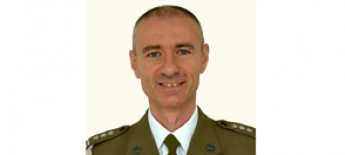
CMDR COE is pleased to announce that COL Jarosław KUBISZ is joining the Centre to run our Transformation Branch activities.
COL Jarosław KUBISZ representing the Polish Armed Forces (PAF). He finished officers′ military school in 1994, and Academy of National Defence in 2002. Last time he served inter alia in Operational Directorate of the General Staff of the PAF and Crisis Management Centre of the Ministry of National Defence. In both mentioned above institutions he has dealing with crisis management matters in PAF and NATO as well.
» read more CMDR COE will conduct Crisis Response Operations Planners Professional Development Course
Crisis management is one of the fundamental security tasks of the Alliance along with collective defense and cooperative security. Depending on the nature of the crisis, different types of crisis management operations may be required. The good operations planning process understanding is essential for all NATO Planners. In line with this, Crisis Management and Disaster Response Centre of Excellence (CMDR COE) developed and will run pilot Crisis Response Operations Planners Professional Development Course from 26th to 28th November 2014. The course will be held in English at Shipka hotel, Sofia, Bulgaria.
» read more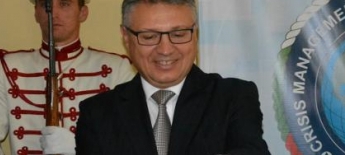 Opening ceremony of the CMDR COE as an International Organization
"We have to learn to counter effectively to the new hybrid type of crisis and disasters, destabilizations and confrontations. And this Centre is a way ahead", stated the Bulgarian president Mr. Rosen Plevneliev in his address to the Opening ceremony of the Crisis Management and Disaster Response Centre of Excellence (CMDR COE) as an International Organization. The ceremony was with the presence of ambassadors and military attaches of diplomatic missions accredited to the Republic of Bulgaria, commanders of the armed forces, and representatives of other ministries and departments.
» read more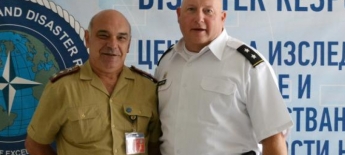 A Standing Invitation to the CMDR COE from the Tennessee National Guard
The Crisis Management and Disaster Response Centre of Excellence (CMDR COE) welcomed Major General Terry M. Haston, the Adjutant General Tennessee National Guard for an official visit on August 7th, 2014.
During his visit, Maj. General Haston had an office call with the CMDR COE Director, Col. Vassil Roussinov. The meeting was attended by Maj Hancock, bilateral affairs officer, Office for Defense Cooperation of US Embassy and CMDR COE branch chiefs, Col Nikolay Nikolov and LtC Dimitar Dimitrov.
» read more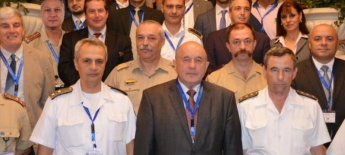 Outstanding upshots gained from the CMDR COE’s Annual Seminar
CMDR COE has successfully hosted its 2nd Annual Seminar, which is designed to facilitate meeting of experts and sharing of experience among bodies dealing with crisis and disaster response. The event took place from 1st to 3rd July, 2014 in Sofia.
Interagency interaction in crisis management and disaster response was the main topic of the seminar. "...If we are united and share our common experiences we will be ready to tackle the different and sometimes unexpected crises and disasters. Crucial for this is the interagency cooperation..." pointed out Rear Admiral Petev in his opening speech.
» read more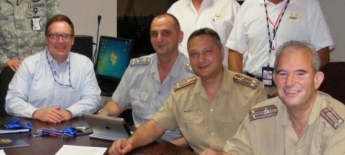 Fruitful cooperation between CMDR COE and TEMA
CMDR COE delegation was in Nashville, Tennessee to attend the four-day 2014 CAPSTONE exercise (16-19 June 14) led by the Tennessee Emergency Management Agency (TEMA). The purpose of this visit was to make acquaintance with the TEMA procedures and practices of designing and conducting disaster response exercises. The current one was on a scenario of an earthquake with magnitude 7.7 resulting into severe impacts in 8 states. During the exercise were briefings and presentations concerning the organization and responsibilities of the state′s entities in response of a disaster. CMDR COE team held meetings with representatives from the private sector and Red Cross & Red Crescent who present their engagements in case of emergencies. The CMDR COE delegation was well received by MGen Terry M. Haston, commissioner of the Tennessee Department of Military as he praised the successful partnership between CMDR COE and the State of Tennessee. He also highlighted ideas for further cooperation as more significant contributions by civilian organizations from NATO countries.
» read more Another International recognition for the CMDR COE
The CMDR COE has received a formal letter of appreciation on behalf of the Croatian Armed Forces General Staff. It recognizes the great efforts CMDR COE Mobile Training Team has done to conduct courses in regard of the of exercise SEESIM 14 preparation process. Expressing special thanks, the Croatian site states the desire to develop cooperation in future.
» read more
 CMDR COE hosted the workshop Military Medical Response in Disaster Management
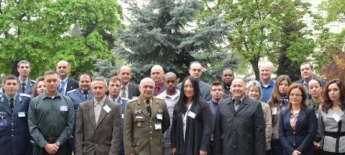
On 28-30 April 2014, the Crisis Management and Disaster Response Centre of Excellence (CMDR COE) hosted the workshop Military Medical Response in Disaster Management, sponsored by US European Command (USEUCOM) and the Bulgarian Ministry of Defence. The 3-day workshop focused on topics related to principles and practices of medical and psychological support in military missions as well as in operations in response of disasters. The workshop was attended by more than 25 participants from the Bulgarian Military Medical Academy, Joint Force Command, Land Forces, Air Force, medical experts from the services HQs, and Bulgarian Red Cross. Informative presentations delivered by instructors of 212-th Combat Support Hospital and Military Medical Academy and fruitful discussions during each session treated of important issues like framework of disaster planning process, components of basic and contingency plans, psychological aspects of disaster reaction and preventive medicine.
» read more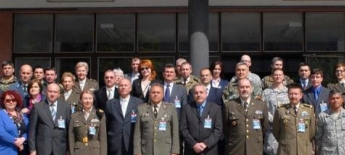 Exercise Planners’ Training Course was conducted by CMDR COE NDA Mobile Training Team (MTT)
The Exercise Planners′ Training Course was conducted by the Crisis Management and Disaster Response Centre of Excellence (CMDR COE) National Defense Academy Mobile Training Team (MTT) in conjunction with the SEESIM 14 Main Planning Conference (MPC) in the Croatian Defense Academy in Zagreb from 31 March to 1 April 2014.
The course was designed to enhance the theoretical knowledge and practical skills of NATO and Partners′ Exercise Planners. The course was attended by 46 participants from Albania, Bosnia and Herzegovina, Bulgaria, Croatia, Georgia, Romania, Montenegro, the Former Yugoslav Republic of Macedonia, USA, Greece, and SEEBRIG.
The participants were familiarized by members of the MTT with NATO and EU approaches in crisis management and disaster response as well the main exercise planning documents and stages. Presentations "Introduction to Exercise Planning Process", "NATO and EU Crisis Management Systems and Mechanisms", "Main Stages in NATO Exercise Planning Process", "Computer Assisted Exercises and Simulations", and "NATO Crisis Management and Operations Planning" was included in the main part of the course.
» read more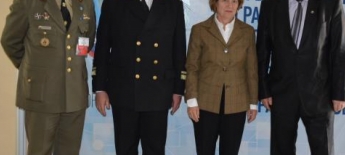 High level visits in the CMDR COE and SABER GUARDIAN exercise
U.S. Ambassador to Bulgaria, Marcie B. Ries paid a special visit to the Host Nation Coordination Cell (HNCC) a component of Saber Guardian 2014 co-hosted by the CMDR COE. The Ambassador took part in a VTC with the 7th Civil Support Commander at Novo Selo Training Area and expressed an active interest in matters of the exercise. The Ambassador familiarized with the objectives and goals of Saber Guardian 14 provided realism to the exercise execution. The CMDR COE then hosted the Ambassador at their headquarters where she met with the CMDR Staff.
» read more CMDR COE participates in the Saber Guardian 2014 Exercise
U.S. Army Europe (US EUCOM) and the Bulgarian Land Forces Soldiers kicked off Saber Guardian 2014 on Mar 31, 2014.
Saber Guardian 2014 is a multinational training exercise designed to reinforce U.S. Army Europe′s commitment to increasing regional flexibility, preserving and enhancing NATO interoperability, and facilitating multinational training.
USAREUR Deputy Commanding General, Maj. Gen. Richard Longo, and Deputy Commander of the Bulgarian Land Forces, Brig. Gen. Krasimir Kanev, will serve as this year′s exercise co-directors.
» read more A Mobile Training Team (MTT) has conducted a Crisis Management and Disaster Response Workshop 17-19 Feb 14, Larissa, Greece
A Mobile Training Team (MTT) consisted by lectures from the CMDR COE and National Defense Academy has conducted a Crisis Management and Disaster Response Workshop. It took place at the South-Eastern Europe Brigade (SEEBRIG) HQ in Greece from 17 to 19 February 2014. The MTT was led by col.Lyubomir Simeonov, Deputy Chief of National Defence Academy
The SEEBRIG was established and activated by seven participating Nations on 31st of August 1999 and is currently located in Larissa. The workshop goals were to provide educational information and details for the Crisis Management understanding and the NATO COEs Network covering the HQ staff area of interest by:
» read more Civil-Military Interaction: Disaster Preparation and Response Workshop has been opened and conducted
A welcoming speech of the Ambassador of the Federal Republic of Germany, His Excellency Matthias Hoepfner has opened the Civil-Military Interaction: Disaster Preparation and Response Workshop, which is taking place in Sofia, 11-13 February 2014. The event is under the patronage of George C. Marshall European Center for Security Studies and co-hosted with the Crisis Management and Disaster Response Centre of Excellence (CMDR COE). The workshop is attended by representatives from civilian and military structures from 11 countries – Albania, Bosnia and Herzegovina, Bulgaria, Germany, Greece , FYROM, Kosovo, Romania , Croatia, Montenegro and USA. In addition on the American side taking part are delegations from the National Guard of the states of Vermont, Maine, Maryland, Minnesota, New Jersey and Tennessee as part of the State Partnership Program.
» read more The Final Planning Conference of the exercise Saber Guardian 14 has finished successfully
The Final Planning Conference of the exercise Saber Guardian 14 was held in Sofia last week (3-7 Feb 2014). The CMDR COE experts headed by LtC Orlin Nikolov, head of Capabilities Branch, participated in the workshops of the Contingency Management Planning/Unified Action (CPM/UA) syndicate.
On February 5, 2015, the CPM/UA members met with representatives of several GOs and NGOs. The meeting was arranged by the CMDR COE and co-hosted with the J9 USEUCOM as there were entities as Bulgarian Ministry of Interior, Chief Directorate Fire Safety and Civil Protection, State Agency of National Security, State Agency for Refugees, Bulgarian Academy of Science, Military Medical Academy, Red Cross, Caritas Bulgaria, Gender Research Foundation, Tennessee National Guard, Bulgarian Modeling and Simulation Association (BULSIM). The purpose of the meeting was to present them the scenario and storyline of their engagement into the exercise.
» read more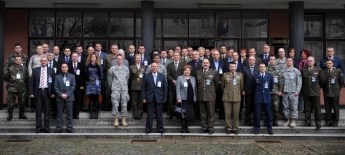 The initial planning conference for the SEESIM 14 exercise was held in Zagreb, Croatia
The initial planning conference for the distributed computer assisted exercise South Eastern Europe Simulation Network (SEESIM 14) was held in Zagreb, Croatia. The Republic of Bulgaria is co-organizer and participates actively in the conducting of the exercise together with the Host Nation. Among the participants are also representatives of Albania, Bosnia and Herzegovina, Georgia, Montenegro, Romania, the Former Yugoslav Republic of Macedonia, United States of America and the SEEBRIG.
The exercise is held under the auspices of the Ministers of Defence of the SEE Nations.
» read more
 CMDR COE FEBRUARY Forthcoming events
- In 3-7 of February experts from the CMDR COE team will take part in the Final Planning Conference of the SABER GUARDIAN ′14 Exercise, organized by the US EUCOM and BGR LANDFORCE.
The purpose of the exercise is to train and educate civilian and military participants in planning and conducting an UN mandated Chapter VII Peace Operation/Crisis Response Operation, based on a Comprehensive Approach, and focusing on co-operation and co-ordination within an unstable environment, involving all stakeholders. The principal exercise focus is the civilian-military cooperation and coordination. The scenario supports exercising a wide range of peace operations functions (e.g. rule of law, humanitarian, etc.). The CMDR COE will contribute to achieving the exercise objectives by providing subject matter expert support in the CMDR area and by organizing distributed point for White cell.
- In 11-13 February 2014 the Civil-Military Interaction: Disaster Preparedness and Response Workshop will take place in Sofia. The workshop is sponsored by the George C. Marshall European Center for Security Studies, the Ministry of Defence of the Republic of Bulgaria and the CMDR COE. The workshop comprises lectures dedicated to NATO and EU Crisis Management, role of military in civil security, risk management, as well as discussions and tabletop exercise.
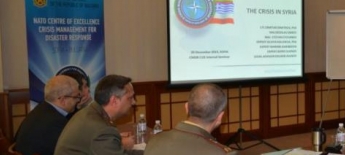 Internal CMDR COE Seminar on the Crisis in Syria
The CMDR COE organised an internal seminar which was held on 20.12.2013. The main focus of the seminar was the crisis in Syria. The CMDR COE experts discussed issued related to the chronology of the crisis; the increased influx of refugees to neighbouring countries and Bulgaria; the positions of NATO, the UN and EU; the involvement of international humanitarian organisations etc.
» read more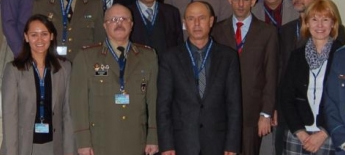 Visualizing Implications of Climate Change on Military Activities and Relationships was conducted
On 11-12 December 2013, the Crisis Management and Disaster Response Centre of Excellence (CMDR COE) co-hosted together with US European Command (USEUCOM) and the US embassy in Bulgaria the workshop Visualizing Implications of Climate Change on Military Activities and Relationships. The opening remarks were given by the Deputy Minister of Defence of Bulgaria, Mr. Ivan Ivanov, who welcomed the participants and underlined the importance of the topics that the workshop focused on.
» read more

